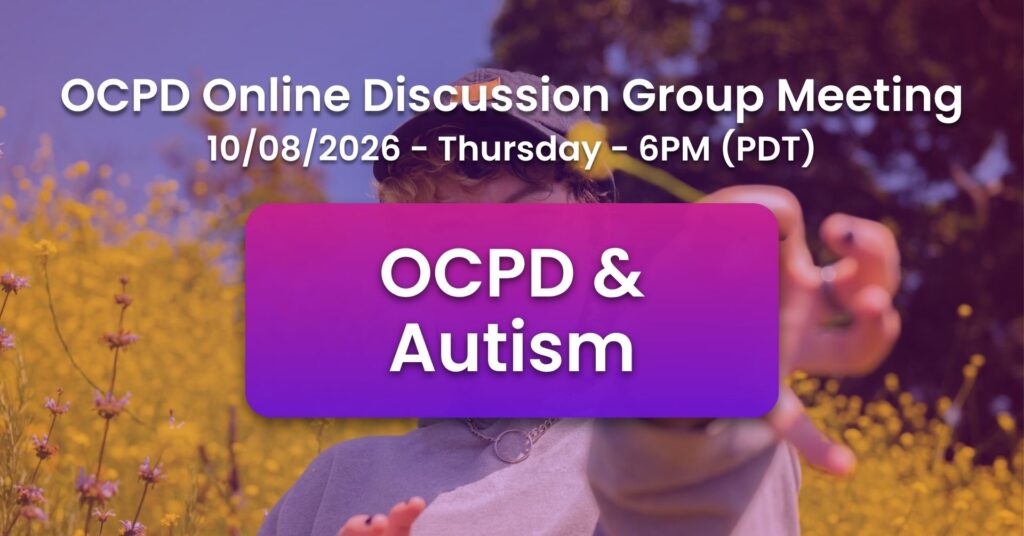
Join our upcoming discussion as we explore the many similarities and distinctions between an OCPD and Autism (ASD) diagnosis. I look forward to hearing from attendees sharing about their own experiences navigating one or both of these diagnoses and what clarity and insight they’ve gained.
Google Gemini AI Summary
Prompt: Summarize what an Autism diagnosis is and isn’t. Provide links to resources. Compare and contrast Autism & OCPD.
An autism spectrum disorder (ASD) diagnosis identifies a lifelong neurodevelopmental variation in how a person processes information, communicates, and interacts with their environment.
What an Autism Diagnosis Is
- A Functional & Neurodivergent Profile: It outlines an individual’s unique sensory processing, social communication style, and pattern of restricted or repetitive interests using modern clinical frameworks (DSM-5-TR / ICD-11).
- A Gateway to Legal Protections & Support: A formal identification unlocks access to accommodations in schools (IEPs/504 plans), workplace adjustments under disability laws, and individualized therapies like speech or occupational support.
- A Framework for Self-Advocacy: For many—especially adults diagnosed later in life—it provides validation, explains sensory burnout or “masking” (camouflaging traits), and fosters connection with the neurodivergent community.
- A Dimensional Spectrum: Modern diagnostics view autism not as a linear line from “mild” to “severe,” but as a dynamic wheel of varying strengths and support needs that can shift depending on environment and stress.
What an Autism Diagnosis Isn’t
- A Medical Disease or Illness: Autism is a structural difference in brain wiring, not a mental illness or medical pathology that requires a “cure.”
- A Metric of Potential or Intelligence: Diagnostic criteria evaluate adaptive functioning and sensory traits, not intellectual capacity, creativity, or future achievement.
- A Behavioral Choice or Defect: Autistic traits—such as stimming (repetitive movements for self-regulation), direct communication, or sensory overload responses—are authentic neurological reactions, not deliberate non-compliance.
- A Uniform, One-Size-Fits-All Label: Because the spectrum is vast, an autism diagnosis does not predict a single universal set of traits, preferences, or personal outcomes.
Credible Resources to Learn More
- Autistic Self Advocacy Network (ASAN): A advocacy organization run by and for autistic individuals, offering plain-language guides and resources on self-advocacy and neurodiversity.
- National Institute of Mental Health (NIMH): A research-backed overview of diagnostic criteria, clinical traits, and co-occurring conditions.
- CDC Autism Spectrum Disorder Information: Reliable data on developmental milestones, screening practices, and demographic research.
- (Cale added) https://embrace-autism.com/autism-tests/: free online tests for autism, ADHD, masking, burnout, alexithymia, and empathy.
Obsessive-Compulsive Personality Disorder (OCPD) and Autism Spectrum Disorder (ASD) are distinct conditions that frequently overlap in outward behavior, particularly around rigidity, a high attention to detail, and a strong preference for structure.
Similarities
- Need for Routine and Predictability: Both autistic individuals and those with OCPD rely heavily on structure, schedules, and consistency. Unexpected changes or disruptions to plans can cause significant distress or anxiety for both.
- Detail-Oriented Focus: Both profiles often involve intense focus on details, lists, rules, organization, or specific systems that others might overlook.
- Interpersonal Strain: Both can lead to friction in social or professional relationships. Others may perceive individuals with either condition as inflexible, overly rigid, or blunt.
- Difficulty with Transitions: Moving from one task, topic, or activity to another can be challenging and frustrating for both autistic individuals and those with OCPD.
Differences
| Feature | OCPD | Autism (ASD) |
| Primary Motivation | Driven by perfectionism, anxiety, and control—a belief that there is an objectively “right” or moral way to do things. | Driven by cognitive predictability, sensory regulation, or deep fascination with specific subjects. |
| Social Communication | Standard understanding of social cues and nonverbal communication is typically intact; conflict arises from imposing high standards on others. | Innate differences in social communication, such as interpreting nonverbal cues, tone of voice, or unwritten social rules. |
| Sensory Processing | Sensory sensitivities are not a feature of OCPD. | Hyper- or hyposensitivity to sound, light, texture, taste, or touch is a core diagnostic feature. |
| Interests & Leisure | Focus is overwhelmingly tied to productivity, work, rules, and duty, often at the total exclusion of leisure or play. | “Special interests” are pursued out of intense personal enjoyment, passion, or comfort, rather than a drive for productivity. |
| View of Rules (Ego-Syntonicity) | Rules are viewed as universal standards; individuals often expect others to conform to their way of doing things (ego-syntonic). | Routines are primarily personal accommodations used for self-soothing or environmental regulation, not usually imposed as moral mandates. |
| Developmental Trajectory | A personality disorder that typically crystallizes in late adolescence or early adulthood. | A neurodevelopmental condition present from early childhood/birth, regardless of when it is formally diagnosed. |
Because OCPD and autism share behavioral traits around routines and order, they can co-occur or be misdiagnosed as one another.
CDC Diagnostic Criteria for ASD
https://www.cdc.gov/autism/hcp/diagnosis/index.html
A. Persistent deficits in social communication and social interaction across multiple contexts, as manifested by the following, currently or by history (examples are illustrative, not exhaustive; see text):
- Deficits in social-emotional reciprocity, ranging, for example, from abnormal social approach and failure of normal back-and-forth conversation; to reduced sharing of interests, emotions, or affect; to failure to initiate or respond to social interactions
- Deficits in nonverbal communicative behaviors used for social interaction, ranging, for example, from poorly integrated verbal and nonverbal communication; to abnormalities in eye contact and body language or deficits in understanding and use of gestures; to a total lack of facial expressions and nonverbal communication
- Deficits in developing, maintaining, and understanding relationships, ranging, for example, from difficulties adjusting behavior to suit various social contexts; to difficulties in sharing imaginative play or in making friends; to absence of interest in peers
Specify current severity:
Severity is based on social communication impairments and restricted, repetitive patterns of behavior. For either criterion, severity is described in 3 levels:[A]
- Level 3 – requires very substantial support
- Level 2 – Requires substantial support
- Level 1 – requires support
B. Restricted, repetitive patterns of behavior, interests, or activities, as manifested by at least two of the following, currently or by history (examples are illustrative, not exhaustive; see text):
- Stereotyped or repetitive motor movements, use of objects, or speech (e.g., simple motor stereotypes, lining up toys or flipping objects, echolalia, idiosyncratic phrases).
- Insistence on sameness, inflexible adherence to routines, or ritualized patterns of verbal or nonverbal behavior (e.g., extreme distress at small changes, difficulties with transitions, rigid thinking patterns, greeting rituals, need to take same route or eat same food every day).
- Highly restricted, fixated interests that are abnormal in intensity or focus (e.g., strong attachment to or preoccupation with unusual objects, excessively circumscribed or perseverative interests).
- Hyper- or hyporeactivity to sensory input or unusual interest in sensory aspects of the environment (e.g. apparent indifference to pain/temperature, adverse response to specific sounds or textures, excessive smelling or touching of objects, visual fascination with lights or movement).
Specify current severity:
Severity is based on social communication impairments and restricted, repetitive patterns of behavior. For either criterion, severity is described in 3 levels:[A]
- Level 3 – requires very substantial support
- Level 2 – Requires substantial support
- Level 1 – requires support
C. Symptoms must be present in the early developmental period (but may not become fully manifest until social demands exceed limited capacities, or may be masked by learned strategies in later life).
D. Symptoms cause clinically significant impairment in social, occupational, or other important areas of current functioning.
E. These disturbances are not better explained by intellectual disability (intellectual developmental disorder) or global developmental delay. Intellectual disability and autism spectrum disorder frequently co-occur; to make comorbid diagnoses of autism spectrum disorder and intellectual disability, social communication should be below that expected for general developmental level.
Note:
- Individuals with a well-established DSM-IV diagnosis of autistic disorder, Asperger’s disorder, or pervasive developmental disorder not otherwise specified should be given the diagnosis of autism spectrum disorder. Individuals who have marked deficits in social communication, but whose symptoms do not otherwise meet criteria for autism spectrum disorder, should be evaluated for social (pragmatic) communication disorder.
Specify if:
- With or without accompanying intellectual impairment
- With or without accompanying language impairment
- Associated with a known medical or genetic condition or environmental factor
- Coding note: Use additional code to identify the associated medical or genetic condition.
- Associated with another neurodevelopmental, mental, or behavioral disorder
- Coding note: Use additional code[s] to identify the associated neurodevelopmental, mental, or behavioral disorder[s].
- With catatonia (refer to the criteria for catatonia associated with another mental disorder
- Coding note: Use additional code 293.89 catatonia associated with autism spectrum disorder to indicate the presence of the comorbid catatonia.
Dr. Megan Anna Neff @ Neurodivergent Insights
[Abridged section below]
OCPD and Autism: Navigating Diagnostic Complexity
The overlap between OCPD and autism adds layers of complexity to the diagnostic process. Studies indicate a significant overlap in symptoms and traits, leading to potential misdiagnosis or missed diagnosis. In some cases, OCPD traits may overshadow autistic traits or vice versa, necessitating a nuanced understanding and careful consideration in the diagnostic process. Recognizing the unique characteristics of each condition is vital to avoid diagnostic overshadowing and ensure accurate identification and support.
OCPD vs Autism: Overlapping Symptoms and Distinguishing Features
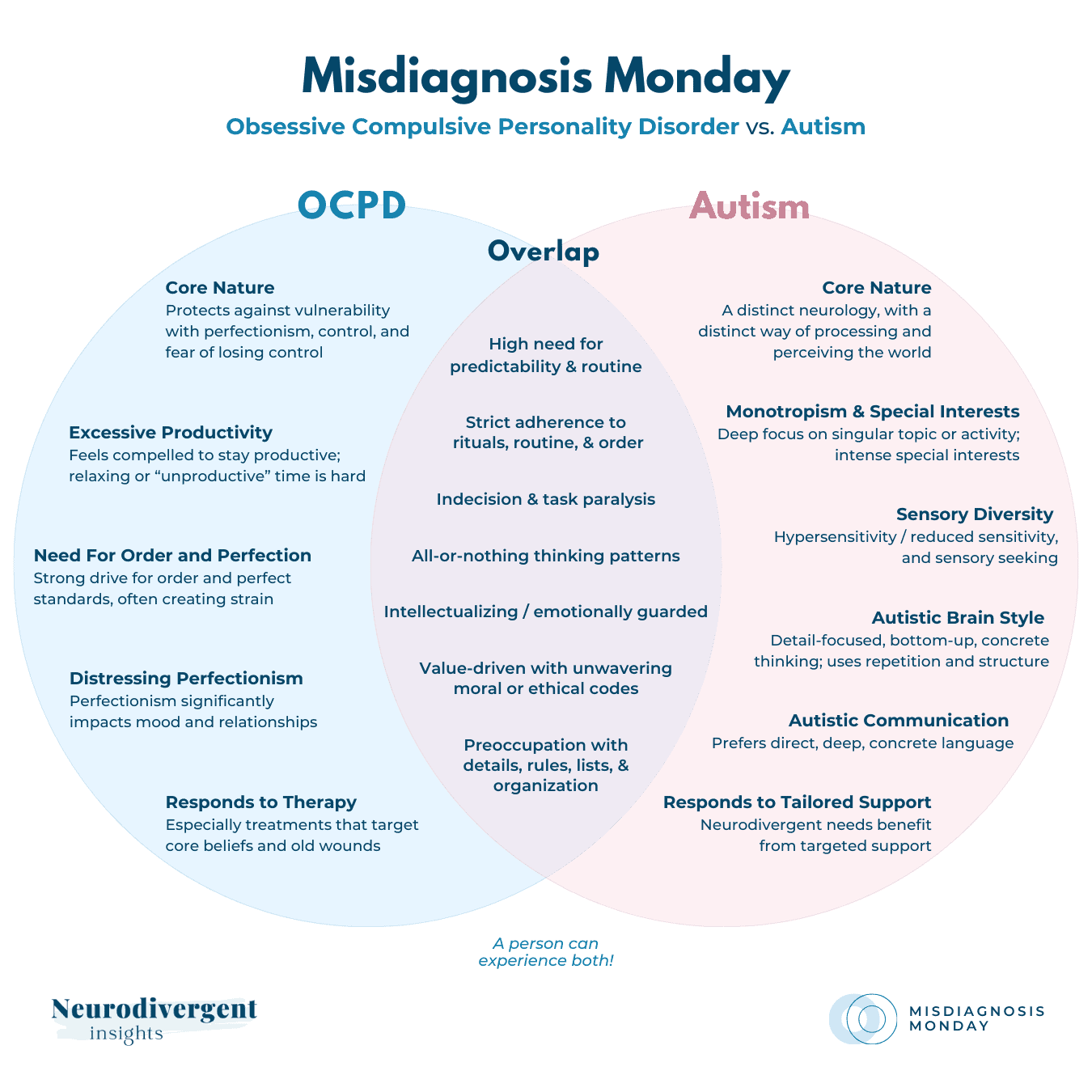
Both OCPD and autism share symptoms like a strong preference for routines, difficulty adapting to changes, and perfectionistic tendencies. However, discerning the motivations and underlying challenges that differentiate them is essential. In OCPD, behaviors are often driven by a fear of imperfection and a need for control. Meanwhile, in autism, they may be more linked to unique cognitive processing styles and sensory sensitivities.
Understanding these distinctions is crucial in providing appropriate support. For OCPD, this might involve addressing unconscious conflicts and modifying core schemas – deeply held beliefs about oneself and the world. In contrast, supporting an Autistic person often focuses on building accommodations tailored to their individual brain style and developing effective self-soothing strategies. Therefore, supporting an individual who is Autistic and also has OCPD involves a nuanced combination of these approaches. It requires addressing the unique aspects of both conditions – tackling the unconscious conflicts and core schemas related to OCPD, while simultaneously building accommodations and supporting the innate brain style and self-soothing strategies beneficial for autism.
While the focus of this article is on distinguishing OCPD from autism, it is important to note that OCPD and autism can also co-occur. In fact, research has shown a high degree of overlap between Autism and OCPD (Gadelkarim et al., 2019).
Distinguishing Autism from OCPD
To develop appropriate support and care, it is critical to thoroughly understand the distinct experiences, challenges, and motivations inherent in autism and OCPD. Clinicians are tasked with navigating the nuanced differences and similarities between these conditions which ensures that diagnostic and therapeutic approaches are tailored to meet specific individual needs.
The following section delves deeper into behaviors common to both conditions, exploring how their fundamental nature differs between an OCPD presentation and an Autistic presentation. This exploration is based on clinical observations and my own hypotheses. It is important to note that further research in this area is highly warranted.